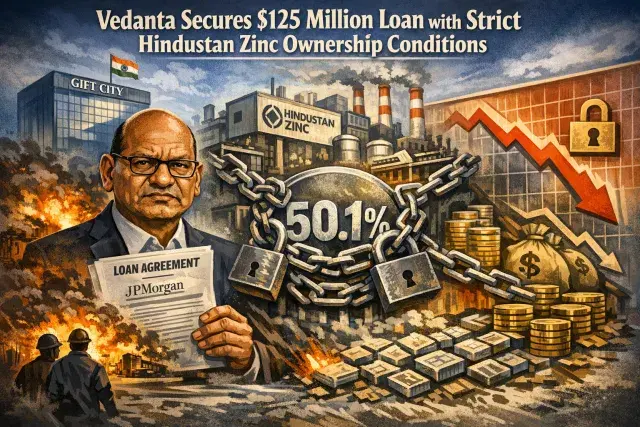
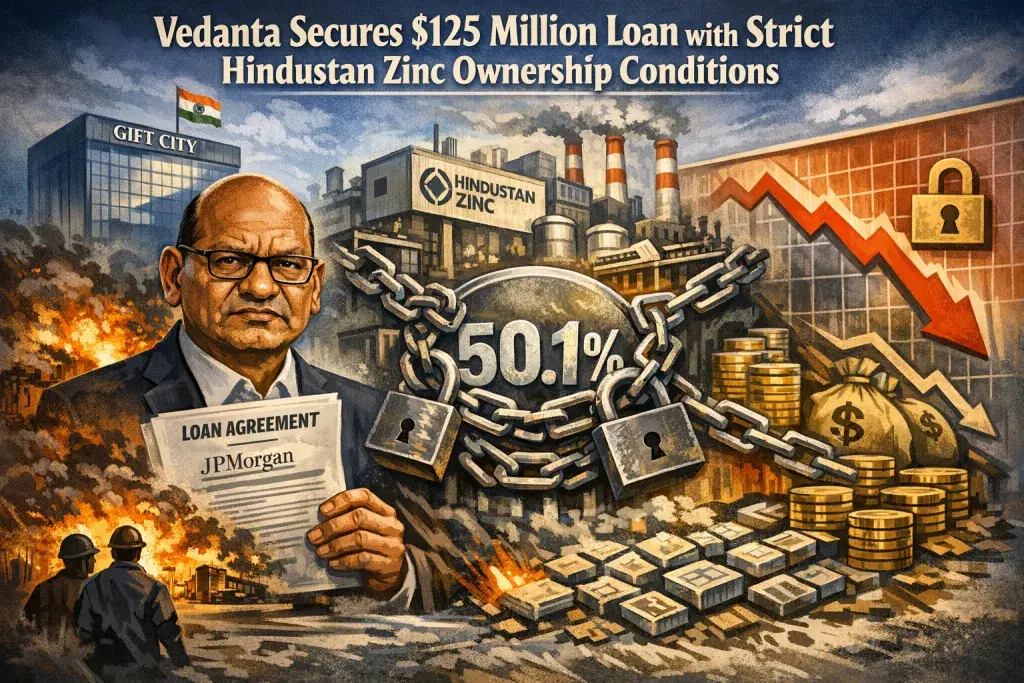
Vedanta Limited has obtained a $125 million external commercial borrowing facility from JPMorgan Chase Bank, but the deal imposes tight restrictions on its control over key subsidiary Hindustan Zinc Limited. The agreement requires Vedanta to hold at least 50.1 percent direct ownership and maintain control until full repayment, barring any sale or security creation on that stake. Signed on April 14 through JPMorgan's GIFT City branch, this financing underscores lenders' wariness over Vedanta's asset maneuvers amid its debt management efforts.
Loan Terms Lock in Subsidiary Control
Vedanta, led by Anil Agarwal, currently owns 60.71 percent of Hindustan Zinc, a major zinc and lead producer critical to its portfolio. Nearly 92 percent of this stake already stands pledged against prior loans, highlighting the company's reliance on subsidiary assets for funding. The new facility, with Axis Trustee Services as agent, explicitly prohibits dilution or encumbrance of the 50.1 percent threshold, ensuring Vedanta retains majority direct ownership and operational oversight during the loan term. This structure protects lenders by safeguarding their collateral value in a volatile mining sector where ownership shifts can trigger share price swings and regulatory scrutiny.
Market Response and Recent Performance
Vedanta shares traded 0.3 percent lower on the NSE amid a rising Nifty benchmark, reflecting investor caution over the ownership covenants. Despite this dip, the stock has surged 29 percent year-to-date, with gains of 6.45 percent over the past five days and 13 percent in the last month. Such performance signals broader confidence in Vedanta's turnaround strategy, which includes debt reduction and asset optimization, though restrictive loan terms may limit flexibility in monetizing high-value holdings like Hindustan Zinc.
Shadow of Chhattisgarh Plant Tragedy
The financing news arrives against a grim backdrop: a boiler explosion at Vedanta's power plant in Chhattisgarh's Sakti district has claimed 20 lives, with 15 workers injured as of April 17. The blast occurred on April 14 at 2:33 p.m. in Singhitarai village, rattling the region's industrial landscape. This incident amplifies scrutiny on Vedanta's operational safety, potentially complicating future borrowings and stakeholder relations in India's resource-heavy economy where industrial accidents underscore the high stakes of expansion.
Implications for Vedanta's Financial Path
External commercial borrowings like this one, often routed through international financial hubs such as GIFT City, provide Vedanta access to dollar funding at competitive rates amid domestic liquidity constraints. Yet the stringent covenants reflect lenders' demand for ironclad assurances in a firm with a history of aggressive divestitures and restructurings. Retaining majority control in Hindustan Zinc preserves revenue streams from India's largest zinc producer but curtails options for deleveraging through stake sales, forcing Vedanta to explore alternative paths like operational efficiencies or non-core asset disposals. As the company navigates these terms, the balance between liquidity infusion and strategic restraint will shape its recovery trajectory in a capital-intensive industry.